
Agriculture in Poland has been changing faster than before for several years. Nowadays, simply running a farm is no longer enough to calmly benefit from subsidies and develop production. Agricultural regulations, documentation, electronic deadlines, environmental requirements and occupational safety are becoming increasingly important. In practice, this means that the farmer has to keep an eye not only on the field or the farm, but also on the farm's compliance with current legislation. In 2026, this is particularly acute with subsidies, GAEC standards, ecology and health and safety-related controls. Find out what changes realistically affect day-to-day farm life today and what you need to watch out for to avoid problems with ARMA or losing some of your support.
New rules for farmers in 2026 - more obligations, electronic controls and changes to farm subsidies
Until a few years ago, many farmers associated agricultural law mainly with the purchase of land or subsidies. Today, the regulations cover virtually every area of farm operation - from environmental protection and documentation to the employment of employees and the use of machinery. The biggest change is the increasingly strong link between subsidies and actual farming. In 2026, a farmer has to demonstrate not only the area cultivated, but also compliance with environmental standards and conditionality rules.
From 15 March 2026, the new regulations include, among other things, the introduction of a definition of 'active farmer', which will entail the need to confirm real activity through sales documents or production costs. The rules for subsidies will also change - particularly for GAEC 2 wetlands, where support can be as high as £2387 per hectare. In addition, farmers will have to keep mandatory electronic records of treatments. The aim of the new rules is primarily to reduce abuses related to the collection of subsidies by people who do not carry out actual agricultural activities and to better protect agricultural land in Poland.
Electronic procedures are also increasingly important. Applications for subsidies are made via the eWniosekPlus system and many checks are based on digital data, satellite images and document analysis. For some farms, this means additional organisational responsibilities and the need to keep an eye on deadlines practically all year round.
Expert advice
On many farms, the problems start not in the field, but with the paperwork. One missing document or a discrepancy in an application can later cost a lot of time and nerves. That is why it is a good idea to have a simple rule: after every major operation, purchase or change on the farm, put the documents in one place right away. It really does make a big difference when ARMA checks it.
Subsidies, GAEC 2 and the active farmer - new obligations to consider on the farm
The most noticeable new rules for farmers at the moment relate to the direct payments scheme and environmental requirements. The application campaign started on 15 March 2026 and is still based on an electronic submission system.
However, the responsibilities are changing. Farmers must comply with so-called conditionality requirements, which include:
- GAEC standards 1-9,
- SMRs 1-11,
- environmental rules,
- social conditionality,
- maintenance of land in good agricultural condition.
There is a lot of talk in particular about the new rules related to the protection of peatlands and wetlands under GAEC 2. It is this element that raises many questions today, as some farms will have to adapt their land use to the new environmental requirements. In practice, the regulations introduce, among other things, restrictions on drainage of such areas, the need to maintain permanent grassland and the exclusion of deep ploughing on designated land, and farmers may be compensated for costs and lost income resulting from these obligations.
In practice, the biggest challenge for farmers today becomes not only knowing the regulations, but also keeping the documentation correctly and demonstrating compliance with ARMA requirements. Even minor errors can result in a reduction of subsidies, additional inspections or financial sanctions. The topic of the 'active farmer' also continues to generate great excitement, as the state is increasingly striving to link financial support to actual farming rather than mere land ownership.
|
Area of change |
Act / document |
What is most important in 2026? |
What does it affect in practice? |
|
Direct payments and area-based payments |
CAP Strategic Plan 2023-2027 and national legislation implementing the CAP |
The 2026 campaign covers direct payments, ecoschemes and Pillar II area payments. The farmer must meet conditionality, i.e. GAEC standards 1-9, SMRs 1-11 and social conditionality, among others. |
Submission of applications via eApplicationPlus, keeping an eye on deadlines, compatibility of parcels, land titles and documentation needed for ARMA inspections. |
|
Active farmer |
National legislation implementing the CAP Strategic Plan 2023-2027 |
In 2026, after the veto of the law on the definition of an active farmer, the existing rules for verification of agricultural activity apply. ARMA continues to verify that agricultural activity is actually carried out on the declared land. |
Subsidies should go to farmers actually using the land. When leasing, the application should be made by the tenant, not the landowner. |
|
GAEC 2 - Peatlands and wetlands |
Good Agricultural Environmental Condition, or GAEC, standards under the CAP |
The requirements for the protection of peatlands and wetlands are of great importance in 2026. This is an element of conditionality, failure to meet which may affect subsidies. |
Restrictions may include land use, drainage, maintenance of permanent grassland and soil-intervening treatments in designated areas. |
|
Organic farming |
Organic Agriculture and Production Act and CAP SP regulations |
From the 2026 campaign onwards, the organic farming intervention abolished the obligation to have an organic business plan and eased some of the penalties for violations of the requirements. Small organic farms up to 10 ha can benefit from simplified support rules. |
Applies to BIO farms, certification, control body inspections, product labelling and documentation of organic production. |
|
Records of treatments with plant protection products |
Law on plant protection products of 8 March 2013 and EU regulations on PPPs |
In 2026, the rules for documenting treatments are unchanged from previous years. The full obligation for electronic treatment records has been postponed until 1 January 2027. |
The farmer still has to document, among other things, the name of the product, the date of application, the dose, the crop, the area treated and the reason for spraying. |
|
Health and safety with agricultural machinery |
Ordinance of the Minister of Agriculture and Rural Development of 14 February 2024 on health and safety at the operation of tractors, machinery, tools and technical equipment used in agriculture |
The ordinance has been in force since 7 March 2024, but in 2026 it is still one of the most important bases for safety control of work on the farm. |
It applies to the operation of tractors, machinery, tools, technical equipment, work organisation, safeguards and accident risk reduction. |
|
Turnover of agricultural land and family farms |
Act of 23 January 2026 on amending certain laws to protect Polish agriculture |
Among other things, the Act amends provisions on the protection of agricultural land and emphasises the importance of family farms. It also provides for the suspension of the sale of property from the Agricultural Property Stock of the State Treasury for 20 years. |
It is relevant to agricultural land circulation, investments, land purchase, protection of family farms and management of the state land stock. |
|
The Act on Formation of the Agricultural System |
The draft Act on amending the Act on shaping the agricultural system adopted by the Council of Ministers on 17 February 2026. |
The draft is intended to simplify the trading of agricultural real estate by entrepreneurs and clarify the provisions on business transformation. The changes are intended to reduce interpretation problems and formalities in certain transactions. |
It applies to the purchase, sale and acquisition of agricultural real estate, especially when converting a business into a company or making corporate changes. |
Health and safety regulations in agriculture are no longer just a formality
Until recently, many farm owners treated health and safety regulations in agriculture as a minor obligation. Today, the situation is quite different. Occupational safety is increasingly coming up during inspections, and violations can even affect subsidies.
Of particular importance are the rules on handling:
- tractors,
- agricultural machinery
- mechanical equipment,
- electrical installations,
- plant protection products.
The new regulations for safe work with agricultural machinery have already come into force, but there has been a marked increase in the number of inspections and an emphasis on documenting training and safety procedures between 2025 and 2026. For farms with employees, there are also obligations under labour law. These include the assessment of occupational risks, the organisation of workplaces and the supervision of duties.
In practice, the problem often turns out to be not a lack of goodwill, but the failure to adapt older equipment to current requirements. Many farms still use machinery that does not meet modern safety standards. This is where the support of a specialist familiar with agricultural law is increasingly needed, as the consequences of negligence can include not only fines, but also civil liability or problems during inspections by state institutions.
New agricultural regulations and farm organisation - land, facilities and safe storage
One of the most important areas governed by the farm regulations remains the marketing of land. The purchase, sale, lease, transfer of a farm or division of real estate still require knowledge of the current rules, and the forthcoming amendments to the Act on the Formation of the Agricultural System are intended to simplify some of the procedures and reduce interpretation problems.
In practice, even a seemingly simple transaction may require analysis of several provisions, especially when it concerns inheritance of a farm, investments on agricultural land or land transformation. This is why farmers are increasingly treating the law in agriculture as part of the day-to-day management of the farm, rather than just a formality needed for subsidies.
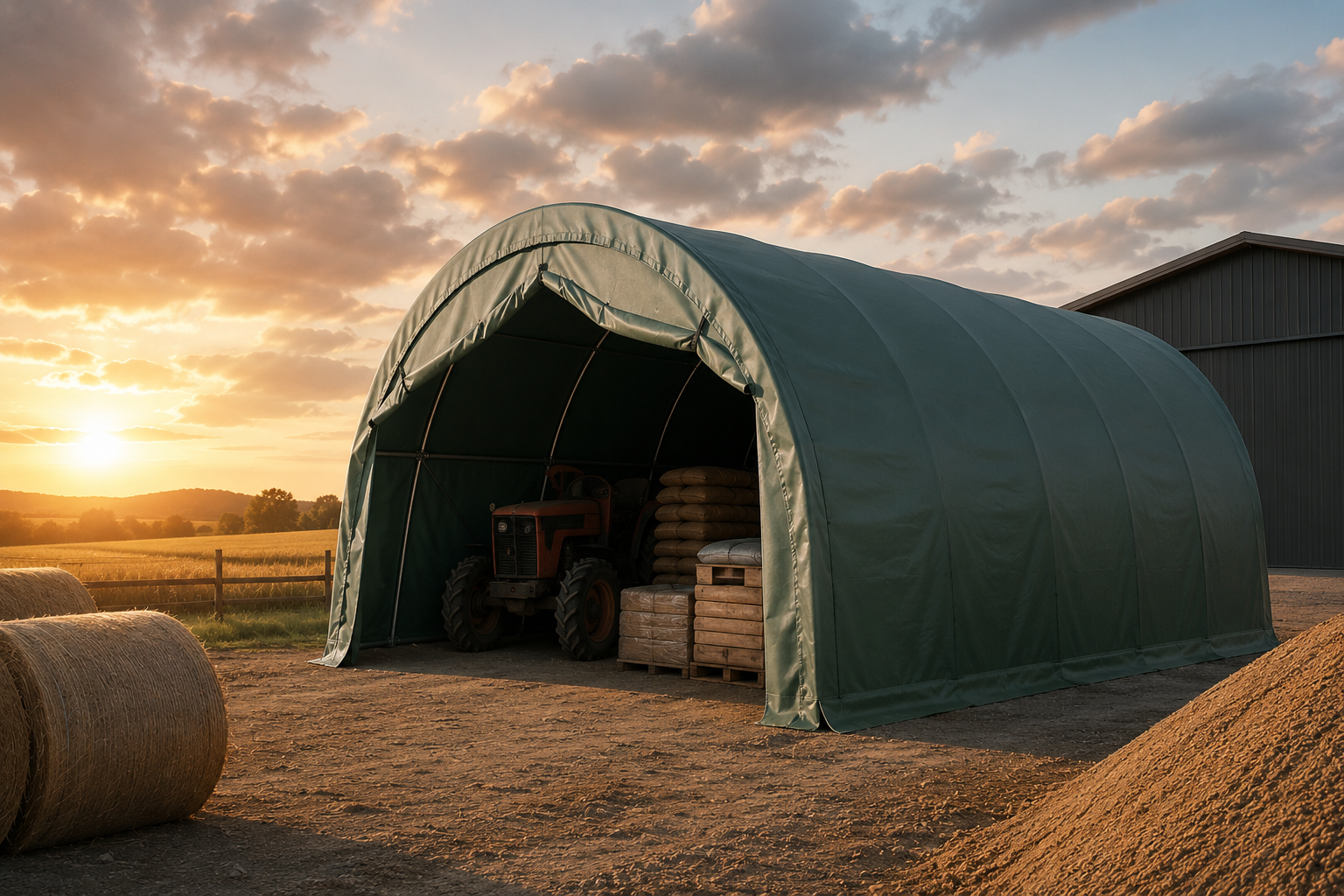
Changes in agricultural law are increasingly showing that a well-organised farm is not only about crops, machinery and subsidies, but also about having a secure space to store equipment, feed, crops, fertilisers or seasonal equipment. New regulations for farmers, greater emphasis on documentation, inspections and health and safety rules mean that farmers are more often looking for solutions that help to quickly get the farm's facilities in order and reduce the risk of loss. This is where the solutions we offer - agricultural tent halls, arched tent halls, utility tents, container shelters or livestock shelters - become practical. With these structures, you can create additional, functional and protected space in a short period of time, without having to plan the long, costly construction of a traditional building.
Frequently asked questions about agricultural law
|
Question |
Answer |
|
What are the most important new regulations for farmers in 2026? |
The changes regarding direct payments, conditionality, GAEC 2 standards and confirmation of actual farming are the most significant. A farmer today has to keep an eye on production, documentation, electronic deadlines and farm compliance. |
|
What is conditionality in agriculture? |
Conditionality is a set of requirements that must be met in order to receive direct and area-based payments. It includes GAEC standards, SMRs, environmental protection, good agricultural husbandry and social conditionality, among others. |
|
What does GAEC 2 mean for the farm? |
GAEC 2 relates to the protection of peatlands and wetlands. In practice, it can mean drainage restrictions, a ban on deep ploughing on designated land and the need to maintain permanent grassland. |
|
Does the Organic Farming Act only apply to BIO farms? |
Yes, it mainly applies to farms producing or planning to produce organically. It regulates certification, inspections, product labelling and the responsibility of organic producers. |
|
Why are health and safety regulations in agriculture so important today? |
Occupational safety is increasingly coming up during farm inspections. This particularly concerns the operation of tractors, agricultural machinery, mechanical equipment, plant protection products and the organisation of the work of employees. |
|
Can documentation errors affect subsidies? |
Yes, irregularities can result in additional explanations, controls or a reduction in subsidies. Therefore, it is necessary to regularly check the data submitted via eApplicationPlus and keep the documents proving the agricultural activity. |
|
When is it advisable to use a lawyer for agricultural law? |
Specialist assistance is useful when buying land, leasing, ARMA inspections, disputes over subsidies or interpreting new agricultural regulations. An agricultural lawyer can also help with contracts, the transfer of farms and the employment of employees. |
|
How do the new regulations affect the organisation of the farm's facilities? |
More inspections, paperwork and health and safety requirements require better organised storage space for machinery, feed, fertiliser and crops. Therefore, solutions such as tent halls, agricultural tents, container shelters or livestock shelters are growing in importance. |
 Previous
