
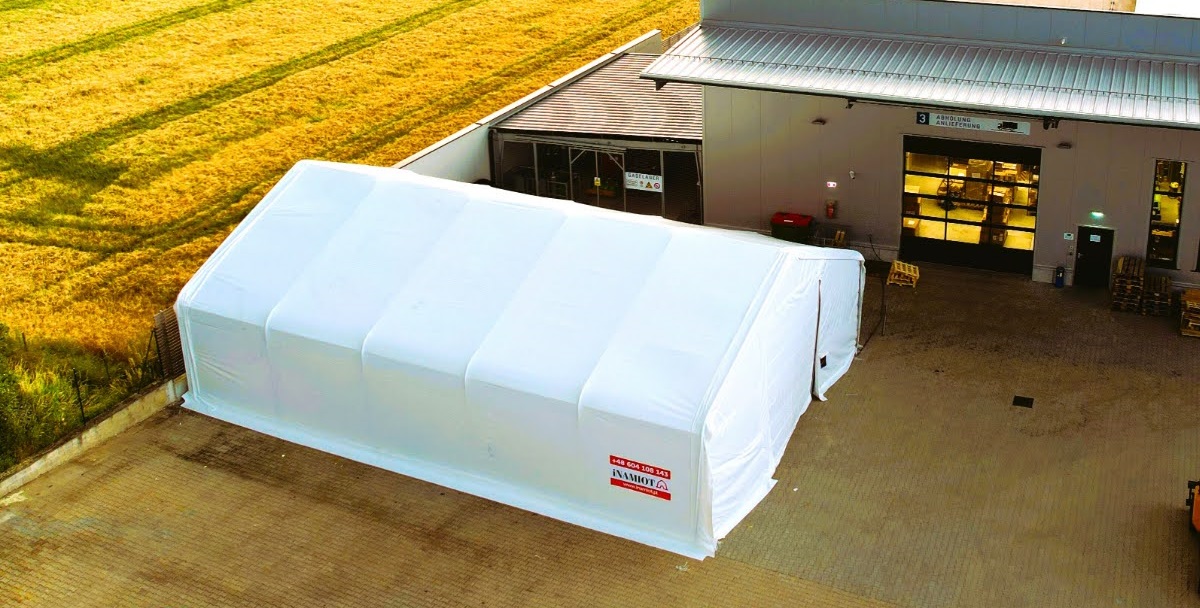
Intense downpours, snowstorms, unpredictable temperature changes - the Polish weather can surprise anyone, and certainly those in need of reliable outdoor storage. It is no wonder that the question "Are tent halls waterproof?" comes back like a boomerang with every investment in temporary structures. After all, nobody wants stock, machinery or materials to suffer through a leaking roof. The good news? With tent halls from Inamiot.EN, you don't have to worry about this. These structures are designed with Polish conditions in mind - neither heavy rain nor snow frighten them.
What makes a tent hall watertight?
The watertightness of a tent halls is not a question of chance - it is the result of well thought-out design and the right choice of materials. The quality of the cladding, the way it is joined and the geometry of the whole structure are all key factors.
Material - PVC fabric
The material of the cladding is the basis. Inamiot.pl tent halls use a durable, multi-layered PVC fabric with a weight range of 750 to 900 g/m². This type of fabric is characterised by its high resistance to atmospheric influences - not only does it provide effective protection against rain, but it also does not stretch under the influence of moisture or wind. In addition, it shows UV resistance, which prevents its degradation and preserves its properties for many seasons. The fabric does not soak up water and its surface allows precipitation to run off freely, without the risk of moisture penetrating into the interior.
Roof shape
Waterproofing is also supported by the geometry of the roof. The shape of the structure plays a key role here - halls with pitched or arched roofs naturally drain rainwater, minimising the risk of it accumulating. As a result, the weight of the water does not accumulate on the roofing, which not only protects the material from overloading, but also further prevents leakage. The arched tent structure, characteristic of many tent halls, promotes self-cleaning of the surface from water and snow and reduces the risk of point pressure.
Meticulous assembly
The method of assembly is also not without significance. Professionally tensioned sheathing, properly fastened to the supporting structure, ensures tightness at the interface between the fabric and the frame. The fastening systems - clamps, rails, tensioners - are designed to seal every element. In combination with the robust hot-dip galvanised steel frame, this results in a stable and leak-proof unit.
Do tent halls require additional sealing?
With standard tent halls from Inamiot.co.uk there is no need for additional waterproofing layers. The PVC sheathing forms a uniform protective coating. Importantly, these structures are sealed: both at the level of the gates and the optional side walls. The available models have the option of a tensioning system for the covering, which further improves the adhesion of the fabric to the frame and reduces the risk of leaks.
An exception may be when the tent halls are to be used as a space for very moisture-sensitive materials (e.g. documentation, electronic devices, pharmaceuticals). Then it is worth considering the installation of additional ventilation, moisture absorbers or even a heating or air-conditioning system to maintain stable microclimate conditions.
Watertightness and operating conditions
Any tent halls, regardless of the tightness of the construction, will be susceptible to dampness if installed in the wrong way. Proper ground preparation is essential: the site should be paved, have a slight slope and preferably a drainage outlet. A well-prepared installation site reduces the risk of flooding of the structure from below during downpours.
Equally important is the correct installation of the hall. Detailed instructions are included with each kit and, if necessary, technical support from Inamiot.co.uk is available. This allows you to avoid common mistakes, such as stretching the covering too loosely or insufficiently anchoring the structure.
Durability of the covering - how long does the hall remain airtight?
The PVC used in Inamiot.pl's tent halls is a highly weather-resistant material. Not only are the covers impervious to water, but they also do not degrade under the influence of UV radiation or low temperatures. Their durability is estimated at several decades of intensive use and, in the case of premium models with double trusses, even longer.
Importantly, EN provides 5-year access to spare parts, as well as lifetime technical support. In the event of any damage, it is possible to quickly repair or replace a section of the covering without having to dismantle the entire structure.
Watertightness in practice: Example applications for tent halls
The high water-tightness of tent halls is proven in everyday use. In the agricultural sector, tent halls are used to store crops, fodder, fertiliser or equipment. These types of materials are particularly sensitive to moisture, so an appropriately airtight construction is crucial - not only does it protect the goods themselves, but also reduces the risk of financial loss associated with damage.
On the other hand, construction companies value tent halls for their ability to store materials and tools in dry, safe conditions. In the logistics industry, tent halls serve as temporary loading terminals, buffer warehouses or sorting points. The impermeability of the shell, the stability of the structure and the possibility of installing gates or lighting make it possible to create a fully functional workspace.
Particularly noteworthy are applications in harsher weather conditions, such as in mountain and coastal areas, where rain, snow and strong wind are commonplace. In such locations, arched halls and gabled halls are ideal, as their construction effectively resists the pressure of water and wind.
Summary: Are tent halls waterproof?
The tent halls offered by EN meet the highest water-tightness standards. PVC covers, a robust steel construction and sophisticated fastening systems ensure that they remain dry even in the event of heavy rainfall. What's more, optional accessories and technical support make it possible to adapt the tent halls to individual needs and local conditions.
If you are considering purchasing a tent hall and want to be sure that it will effectively protect your assets - contact the advisors at Inamiot.pl. They will help you select the optimal solution, taking into account all technical and weather aspects.
 Previous

