
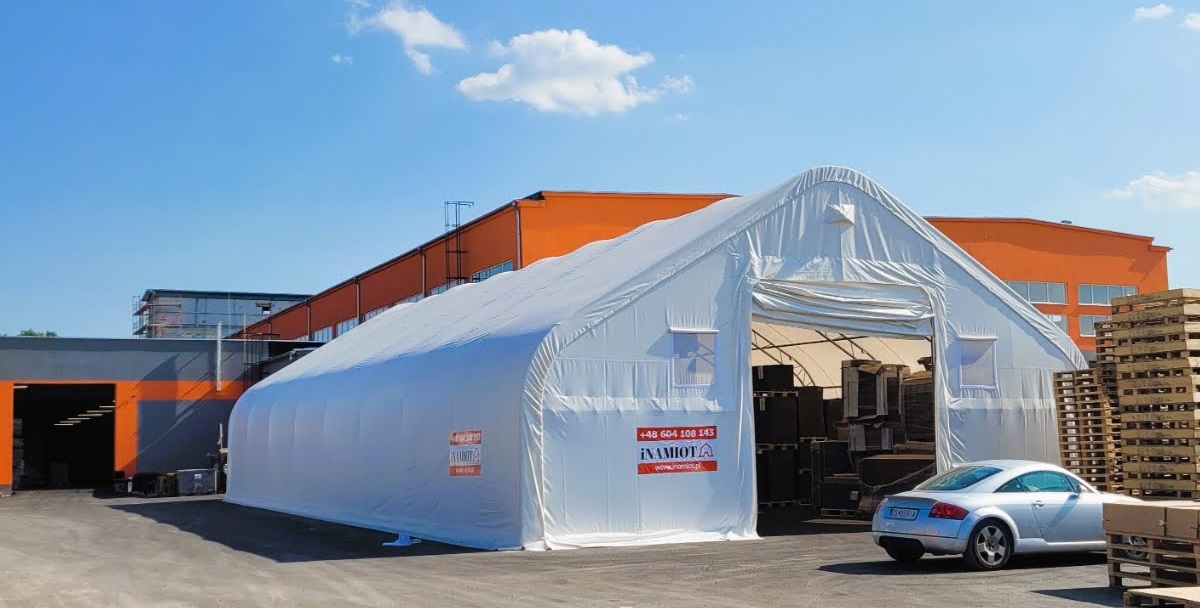
erecting a tent halls appears to be a quick and simple solution, but in practice the formal issues can surprise even experienced investors. The question arises: does a tent hall require a building permit? This depends on several key factors: the duration of use, the foundation method and the technical parameters of the structure. It is important to know these before erecting the hall on your site, as misinterpretation of the regulations can mean not only delays, but also serious administrative consequences.
Do I need a permit for a tent hall?
According to the current legal provisions (Construction Law, Act of 7 July 1994, Journal of Laws 2023, Art. 29.1(3) and (7)), the time of use and the foundation of the tent hall are of key importance. If you plan to use the tent warehouse halls for less than 180 days and the structure is not permanently attached to the ground, a construction notification is sufficient. The document is submitted to the County or City Hall on whose land the structure is to be erected.
If the tent halls are to remain in one location for longer than 180 days or if the structure will be permanently connected to the ground (e.g. through foundations, concrete anchors or fixed installations), it is necessary to obtain a full construction permit. Such a facility is treated as a building under the law and therefore requires a construction project and the passage of a full administrative procedure.
Temporary halls - up to 180 days of use
In the case of halls and storage tents used for a maximum of 180 days, a construction notification (form PB-2) submitted to the Municipal or District Office is sufficient . It is not necessary to obtain a full building permit or employ a construction manager.
This form of notification allows legal use of the warehouse without having to go through complicated administrative procedures. In practice, this means that assembly work can begin almost immediately - this applies to structures of up to 35 m².
Year-round halls - more than 180 days of use
If you plan to use your warehouse tent halls for more than 180 days, you must reckon with the requirement for a building permit. This also applies if the tent warehouse halls are to be permanently connected to the ground, e.g. via foundations or anchoring. In practice, this means that all-season storage tents or workshop workshop halls are treated as fully-fledged construction objects and require a full administrative procedure.
How do I obtain a construction permit for a storage hall?
Obtaining a permit for the construction of a storage hall requires the preparation of complete documentation and going through the formal procedure set out in the Construction Law. First, an application for a building permit (PB-1 or PB-8 form) must be submitted, together with an architectural and construction design and a land development design. The set of required documents also includes a statement on the right to dispose of the real estate for construction purposes and a current extract and extract from the local spatial development plan or a decision on land development conditions. The complete project must be prepared by a person with the appropriate qualifications and its scope includes both the construction and installation part and an analysis of the impact of the facility on the surroundings.
Once the documents have been submitted, the office begins theadministrative procedure, which normally takes about 65 days, although the process may be longer in the case of complex investments. It is also compulsory to appoint a construction manager and, in many cases, an investor supervision inspector, who will be responsible for the proper course of the works. After obtaining the permit, the investor still has to declare his readiness to start the works - the office has up to seven days to do so, after which the construction can legally start. Only after these stages have been passed does the actual construction of the storage hall begin in accordance with the approved design and building regulations.
Permit for tent halls - notification costs and tax complexities
The costs associated with declaring or obtaining a permit for a tent halls are not only administrative formalities, but also a number of tax consequences. If the structure is deemed to be a building as defined by the regulations, the owner has to reckon with higher property tax, which covers permanent rather than temporary structures. In addition, with halls used for commercial activities, VAT liabilities may arise, especially if the facility generates revenue or is part of the company's infrastructure. The owner also has the option to include the hall in the fixed asset register - most often in the KŚT group 291, which allows depreciation at an annual rate of 4.5%.
Tent halls for notification - where do I have to provide the documents?
If a permit for erecting a tent is not required, the documents relating to the notification of tent hall construction should be delivered to the Poviat Starosty or City Hall with jurisdiction over the location of the planned investment. It is these authorities that check the completeness of the notification, analyse the compliance of the facility with regulations and confirm whether the hall may be erected without the need to obtain a construction permit.
The application must include, among other things, a sketch or land-use plan, a technical description of the facility and a declaration of the right to dispose of the property. Upon submission of the documentation, the office has 21 days to object - if it does not do so, the investor may legally proceed with the erection of the tent halls.
Tent halls - permission in the case of a structure connected to the ground
In the case of a tent hall permanently connected to the ground, the obligation to obtain planning permission arises even if the planned period of use does not exceed 180 days. Structures that are anchored to the ground, set on foundations or have permanent installation elements are treated by law as structures and not temporary structures. This means that a construction project must be prepared and a full administrative procedure must be followed.
A permit will also be required if the building area exceeds 50 m², the height of the object is greater than 4.5 m, or if the hall is closer to the plot boundary than half its height. In such situations, notification of the erection of a tent hall is not sufficient, as the facility becomes potentially significant for the environment and the safety of users. It is therefore advisable to carefully analyse the parameters of the hall before commencing the investment to avoid formal complications later on.
Do I need planning permission to erect a storage tent? Let us summarise
A notification is sufficient if the tent hall is used for up to 180 days and is not permanently connected to the ground.
The notification shall be submitted to the County Office or the City Council of the county.
The authority has 21 days to raise objections - failure to respond means consent.
A building permit is required if the hall is to stand for more than 180 days or is connected to the ground (foundations, anchors, installations).
Permission is also necessary when:
- the building area exceeds 50 m²,
- the height of the building is greater than 4.5 m,
- the distance from the plot boundary is less than half the height of the hall.
Obtaining a permit requires the submission of a PB-1 or PB-8 application together with a construction project and documents concerning the plot.
The administrative procedure usually takes about 65 days plus an additional 7 days to notify the start of work.
A hall deemed to be a building is subject to higher property tax.
A commercial building may generate VAT liabilities.
A hall can be entered in the fixed asset register as TIN 291 with a depreciation rate of 4.5% per annum.
Therefore, if you plan to use such a facility for more than 180 days, you must expect to obtain permission to erect a tent halls. This also applies if the tent warehouse halls are to be permanently connected to the ground, e.g. through foundations or anchoring. In practice this means that all-season storage tents are treated as fully-fledged construction objects and require the full administrative procedure to be passed.
 Previous
