
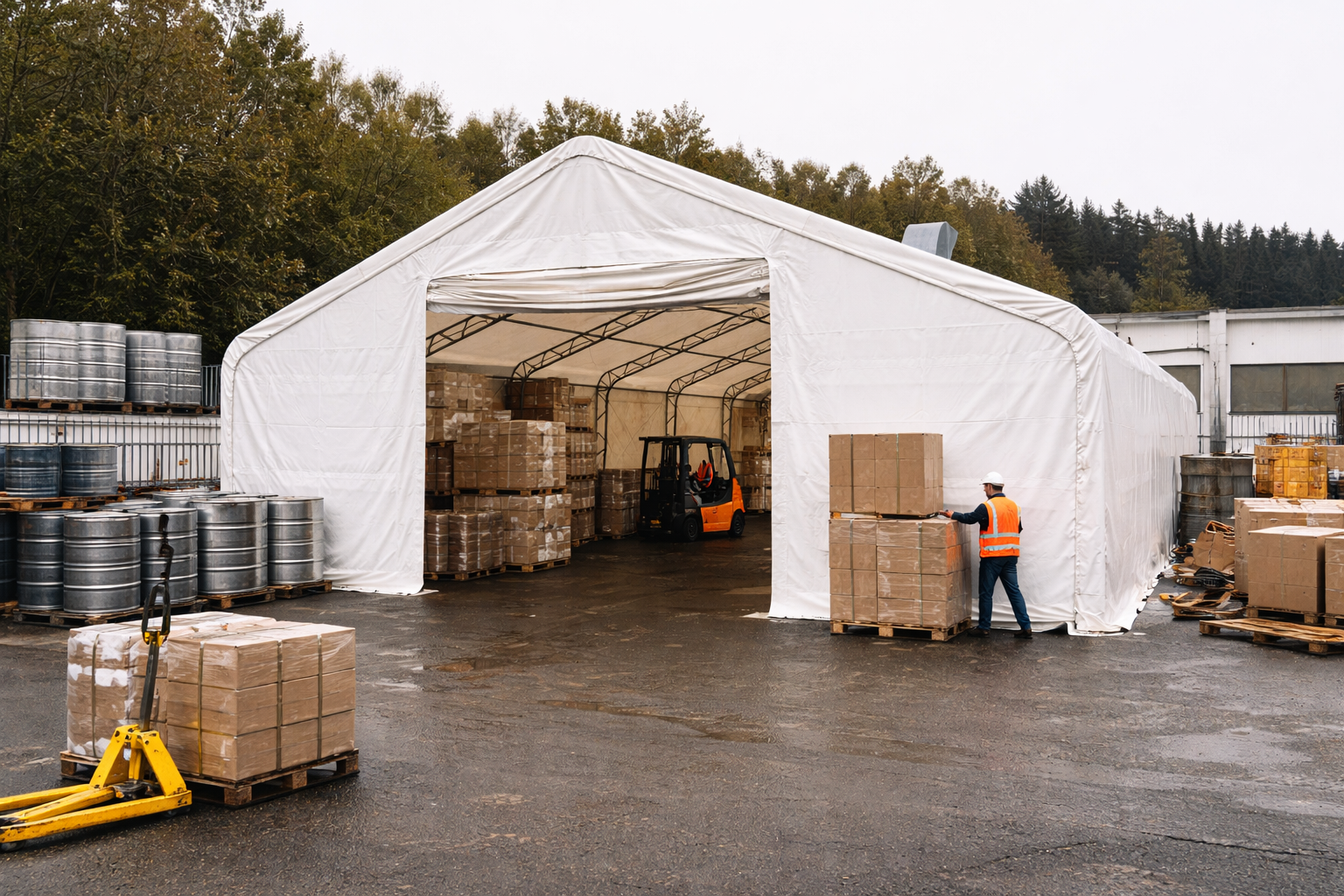
A tent halls can be a convenient and quick solution, but their legal status is never 'given in advance'. Whether it is treated as a temporary structure, a building or - in extreme cases - a building, is determined by its specific technical features, the duration of its use and how it is erected, not by the name of the structure itself. If you are planning to erect a hall, always check how long it is expected to stand for, whether it interferes with the ground and the position of the local authority, as these are the elements which most often determine formalities and taxes. An informed approach at the planning stage avoids costly adjustments, disputes and unpleasant surprises after installation.
Is a tent halls a building? Building law says "it depends". - check what exactly
The first, fairest answer is - building law doesn't give one simple label that can automatically be stuck to every tent halls. And it is this lack of zero-singularity that causes most problems in practice. The legislator operates with specific technical and functional criteria and not with the name of the object used in everyday language or marketing. This means that it is irrelevant whether the manufacturer calls the structure a 'hall', a 'tent' or a 'pavilion' - what matters is how it is erected, how long it is used and how much it interferes with the ground. If you are expecting a simple 'yes' or 'no', then unfortunately you have to be patient, because the answer always depends on details that are often overlooked at the planning stage of a project.
In practice, authorities and courts look to statutory definitions, and these are quite precise, although not always intuitive. A building must be permanently attached to the ground, have foundations, a roof and separate building partitions. In the case of tent halls, the problem is primarily the lack of foundations and the possibility of dismantling, which automatically undermine the fulfilment of these conditions. On the other hand, if the structure stands for a long time, is stabilised, connected to utilities and has a storage or production function, the official is no longer looking only at theory, but at the actual use. Therefore, it is already worth being aware at this stage that every technical detail can have legal significance - and one that later translates into paperwork, taxes and liability.
Tent halls - building or structure? One question, three interpretations and real consequences
This is one of those questions that sounds innocuous, but in reality opens up a whole can of interpretive disputes. A tent halls very rarely meets the definition of a building, but this does not at all mean that it automatically 'falls' out of the building law system. In practice, it most often ends up in the category of building structures, or more precisely temporary buildings, which in itself raises further consequences. And this is where the problem arises - construction law and tax law do not always speak the same language, and their definitions can differ. The result? The same object can be assessed quite differently depending on who is looking at it.
The first interpretation is that a tent halls is a typical temporary structure, which is neither a building nor a structure in the classical sense. The second - increasingly used by municipalities - attempts to 'pull it up' under a building, especially if the structure stands for a long time and is used for business activities. The third, the rarest but most costly, occurs when the hall is permanently erected, equipped with foundations or permanently anchored elements - in which case it can be considered a building.
Each of these interpretations of the building regulations for tent halls means different formal obligations, different risks and completely different financial burdens, so it is not worth treating this question as a purely theoretical consideration.
Is a hall a building according to the authority - a dispute that could cost tax
This is where the area where many investors are frankly baffled begins. Tax authorities and local authorities very often look at tent halls through the prism of property tax rather than the pure definition from the Building Law. In their assessment, what matters is whether the facility is functionally related to the business, whether it stands for an extended period of time and whether its dismantling is in practice only theoretical. In such cases, the temptation arises to consider the hall as a building, which automatically opens the way to taxing its value. And this is where the disputes begin, which can drag on for years.
The administrative courts are not unanimous on this issue, which further complicates the situation. On the one hand, there are judgments indicating that a tent halls, as an object not explicitly listed in the catalogue of structures, should not be taxed. On the other hand, there are rulings which emphasise that the actual use may prevail over the formal qualification. The result is that the same type of hall in one municipality is not subject to tax, while in another it is.
If you are running a business and plan to use the hall in the long term, this dispute is not abstract - it can directly translate into tax on the tent halls and, in extreme cases, also into tax arrears.
Is a marquee a structure under the regulations or just a 'temporary structure'? The boundary can be thin
Construction law uses the concept of a temporary structure, which at first glance seems to fit perfectly with tent halls. Such a structure is intended to be used for a limited period of time, has no permanent connection to the ground and can be moved or demolished without disturbing the structure of the site. This sounds clear in theory, but in practice the problem is precisely the interpretation of the term 'temporary'. For is an object in use for a few months still temporary? What if it has been standing for two years, but can formally be dismantled in a week?
The boundary between a 'tent' and a 'structure' begins to blur when stabilisation elements, connections, installations and permanent equipment appear. Even without foundations, the authority may consider that the structure has a permanent function and that its dismantling is only potential, not real. And it is in such cases that it becomes crucial to document the nature of the use and not just the technical performance. If you are treating the hall as a seasonal or temporary solution, you need to demonstrate this realistically, not just declare it. Otherwise the 'temporariness' may be challenged sooner than you expect.
It is worth emphasising that the same rules apply not only to classic storage halls, but also to agricultural halls, utility tents and workshop tents, regardless of their purpose. The function of the structure does not protect it from legal assessment - if the structure stands for a long time, is equipped with fixtures and fittings and realistically replaces a permanent structure, the authority will apply identical criteria, regardless of whether agricultural machinery, equipment or day-to-day operations are stored there.
Tent halls as a structure after 180 days? Find out when the notification ends and the permit begins
One of the most practical and at the same time most often overlooked criteria is the time of use of the structure. Building law clearly indicates that a tent halls in use for up to 180 days can be constructed on the basis of a notification, without a building permit, without a construction manager and without full design documentation. This is a huge simplification that makes it tempting to treat this deadline flexibly. The problem is that 180 days is a hard limit, and exceeding it - even unintentionally - changes the legal situation dramatically.
After this period, the facility ceases to be an 'innocent' temporary solution and starts to fall under the regime of a building permit. This implies the need to prepare a design, appoint a construction manager and obtain an administrative decision, the absence of which may result in sanctions. Moreover, long-term use increases the risk that the hall will be classified as a structure on tax grounds as well.
If you are looking for reliable and safe solutions, the iNamiot tent hall manufacturer offers high quality workmanship and a wide range of canopies to suit various applications. A well-thought-out construction, robust materials and the ability to flexibly adapt the hall to the real needs of use make it easier to meet formal requirements and reduce the risk of legal problems right from the operational phase.
 Previous
