
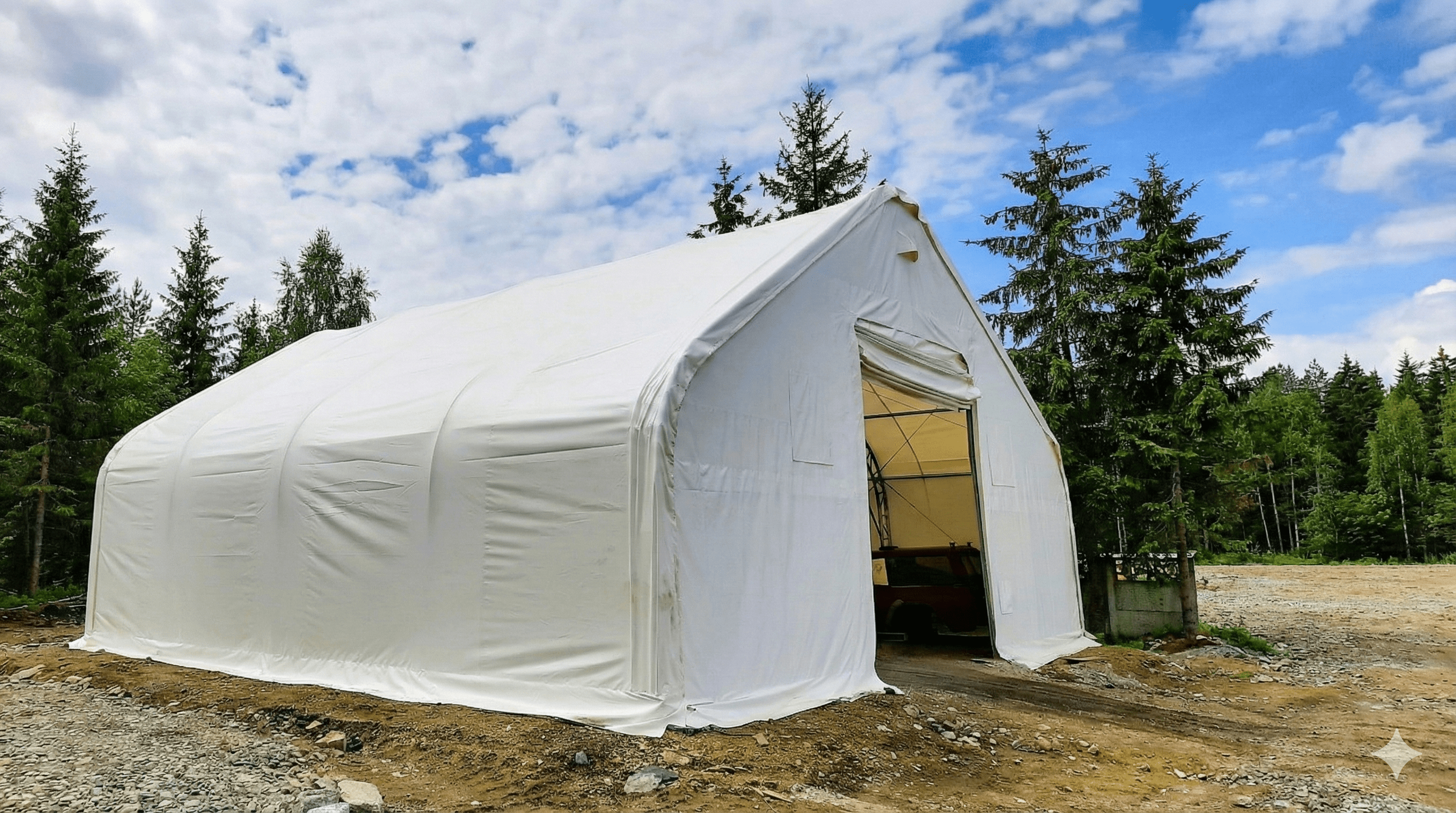
A storage tent can be a great solution for a company, but only if you correctly determine its classification from the outset and choose the right depreciation rate. It is this step that determines whether your accounts will be favourable and tax-safe or, on the contrary, cause unnecessary problems. Below you will find a practical and very accessible guide that shows, step by step, how to approach the subject, what to pay attention to and which variants of the TIN are really at stake. This will help you decide more quickly which classification to use and how to account for the structure in accordance with the regulations.
TENT HALL TILES WITHOUT SECRETS - check how to recognise the correct classification before the office does it for you
What often escapes entrepreneurs is that the classification of a fixed asset does not depend on what the structure looks like "to the eye", but on its technical features. When you are analysing a hall, pay attention first and foremost to the durability of the connection to the ground, as this determines whether you are dealing with a structure considered as a free-standing object or rather as a civil engineering object. If the structure can be dismantled without losing its use value and the load-bearing elements are fixed with bolts, anchors or prefabricated concrete footings, this usually steers you towards a classification in accordance with NUTS 806, which is confirmed by many tax interpretations.
On the other hand, if the facility is equipped with reinforced concrete foundations and the dismantling would require a lot of earthworks, the classification may go towards TIN 291, which carries completely different consequences for depreciation and paperwork. Therefore, before you enter the hall in the records, it is a good idea to confirm the actual foundation and have technical documentation to confirm that the structure has been designed to be relocatable. Getting this sorted out at the outset really saves nerves later - especially when the office starts asking for details or refers to the CSO classification, which is not binding in tax practice. The better you know your hall, the quicker you can determine the correct TIN, which translates directly into more favourable depreciation.
Step-by-step depreciation of a warehouse hall - choose a rate that is compliant with regulations and friendly to your wallet
If you're wondering where to start, the answer is simple - with the right classification, because it determines which depreciation rate for the warehouse hall will be applied. In the case of structures not permanently attached to the ground - i.e. those that can be unscrewed, dismantled and set up elsewhere - the 10% rate is not only the most commonly used, but also confirmed by numerous interpretations of the NIT. In practice, this means a fairly quick settlement of investment costs, which is particularly relevant if you are investing in a hall to increase storage or production space without the need to erect permanent buildings.
If the structure does not fall within the definition of 806, because, for example, its technical specification goes beyond standard free-standing facilities, the TIN 808, i.e. a rate of 20%, may come into play. This solution arises less frequently, but in some cases it can be advantageous, especially when it is important to recognise costs quickly over time.
On the other hand, when the hall is equipped with reinforced concrete foundations and the whole forms a single civil engineering object, depreciation drops to 4.5% per year (or even 2.5% in some interpretations). For entrepreneurs, this means a real extended depreciation period for the investment, so it is worth analysing whether the foundations are indeed permanent.
This is because a warehouse hall of the NIT can be classified as two separate fixed assets - the foundations as NIT 101 and the structure itself as NIT 806. This is often the most reasonable compromise, as it allows the hall itself to be depreciated more quickly and the foundations over a longer period. If you want to be sure that the chosen rate will not be questioned, be guided by the technical documentation, the description of the assembly and the real possibility of dismantling the structure - these are the foundations for safe depreciation.
Storage tent hall - depreciation rate 10%, 20% or maybe 4.5%?
It is a good idea to get your decision-making process in order before you even choose a depreciation rate. The most important question you need to ask yourself is whether the structure is permanently attached to the ground or not.
This will help you determine which rules actually apply and whether your investment can be depreciated more quickly or whether it needs to be recognised over a longer period. It is the way it is founded and the possibility of dismantling that determines whether you will benefit from a rate of 10%, 20% or 4.5%, regardless of how large the structure itself is. The more carefully you analyse these elements at the outset, the less risk there is of the authority challenging the classification you choose.
Depreciation of a storage tent not tied to the ground - see when you can legally benefit from 10% or one-off depreciation
For structures that can be dismantled and moved, the regulations open up the possibility of taking advantage of rapid depreciation and, in some situations, a one-off write-off. If your structure meets the conditions that usually define the depreciation of a storage tent not attached to the ground, you can count on both the standard rate of 10% and, in selected cases, degressive depreciation. From the entrepreneur's point of view, this means a real acceleration of settlements, especially if you are looking for a quick return on your investment. Group 8 fixed assets also allow you to benefit from one-off write-offs of up to PLN 100 000, provided, of course, that the structure is new and meets certain technical criteria.
However, it is worth remembering that the tax office will verify the method of assembly and documentation. That is why it is so important that you have a technical specification which clearly describes that the structure is not permanently attached to the ground. Counter-intuitively, it is not just about the lack of reinforced concrete foundations, but also whether the structural elements can be unscrewed without damaging the whole. It is this feature that is key in the KIS interpretations, which have repeatedly confirmed the 10% rate for structures that meet the conditions of a typical storage tent. If you are concerned about full tax security, it is also a good idea to take photo documentation of the assembly - the authority often pays attention to such details. Proper preparation and a good description of the structure ensure that depreciation runs smoothly and without the risk of disputes with the tax authorities.
Does your storage tent hall of the TPC really meet the 806 conditions? Here is a checklist to go through before your accountant takes the first write-off
Before you enter the structure in your records, it is worth going through a short analysis to help you assess whether you do indeed meet the conditions of the TIL 806. The most important question is: is the hall permanently attached to the ground? If the structure is based on point foundations or prefabricated footings that allow a stable but still reversible foundation, this usually gives rise to the 10% rate. On the other hand, the use of mechanical or chemical anchors can also indicate that the building meets the conditions of a typical lightweight construction hall.
In the second step, pay attention to the documentation. The manufacturer's statement, technical drawings, installation diagram and photographs of the foundation often prove crucial in the event of an inspection. If the foundations are a separate structure, don't forget to consider their separate recognition according to TIN 101, as confirmed by numerous NIS interpretations. Such a strategy not only reduces the risk of incorrect classification, but also gives you the opportunity to account for the value of the hall itself more quickly. Before the first write-off, also make sure that the metric does not mislead you - even a storage tent hall above 100 m² of the NIT can still fall under code 806.
Thestorage halls and tents available from iNamiot are portable structures that fully meet the requirements of the NACE classification 806 (Kiosks, sheds, barracks, camping cabins) entitling you to depreciation at a rate of 10% per annum. A key feature determining this classification is that iNamiot products are not permanently attached to the ground. Entrepreneurs choosing storage solutions from iNamiot receive not only the flexibility and functionality of the space, but also favourable tax treatment and the ability to quickly deduct investment costs
 Previous

