
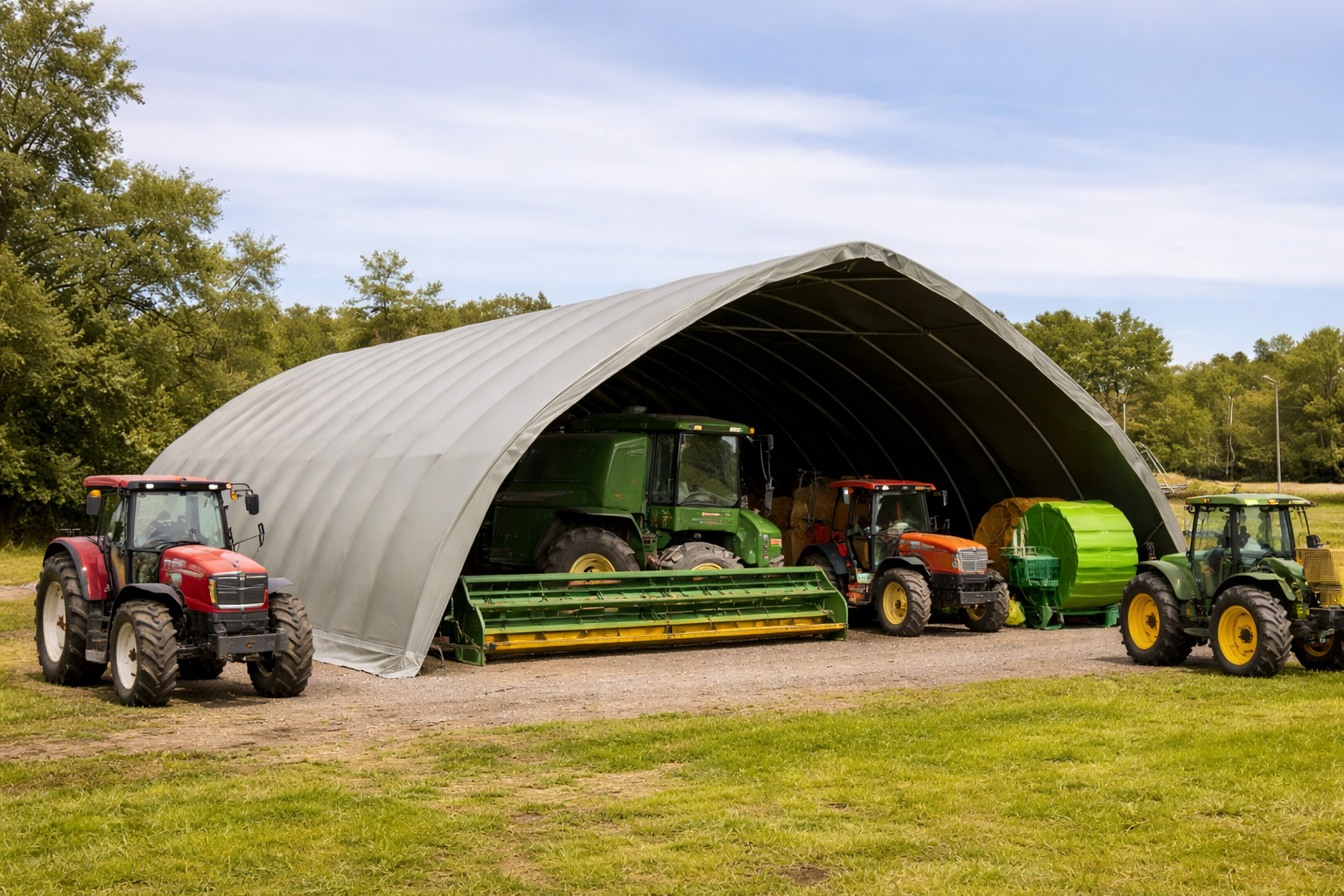
Storing agricultural machinery is not just a matter of keeping the farm tidy; above all, it is a decision that directly affects costs, the durability of the equipment and working comfort. If machinery stands unused for most of the year, how it is protected becomes crucial. That is precisely why more and more farms are looking for solutions that combine effective protection with a reasonable budget and quick implementation.
Why is space running out on the farm – and how can the problem of equipment storage be solved?
On a farm, specific needs arise every day – space for equipment, room to manoeuvre, the ability to access machinery quickly and store it safely out of season. In practice, it is not just a question of where to “put” things, but how to organise the entire logistics so that work runs smoothly and without problems. As the amount of equipment increases and its size grows, space begins to run out, and makeshift solutions are no longer enough. That is when the need arises for a more thought-out infrastructure – one that allows you to maintain order, reduce preparation time and avoid chaos during the season.
That is why mobile solutions, such as agricultural tents, are increasingly being chosen, as they can be adapted to the farm’s current needs. Their advantages include flexibility, quick assembly and the ability to change location without significant costs, which is of great importance in agriculture. Well-planned equipment storage is not only about protection from the weather, but also about the efficient organisation of the entire facility – from parking machinery to servicing it and preparing it for work. If everything has its place and access is simple and intuitive, day-to-day work simply becomes easier and more predictable.
Why is machine storage a financial issue?
At first glance, it may seem that storing equipment is merely a matter of keeping the farm tidy, but in practice it is about something far more important – real money that either stays in the budget or slips away from it. Most agricultural machinery is in use for a relatively short period of the year, and for the rest of the months it simply stands idle. If, during this time, they are exposed to moisture, temperature fluctuations or UV radiation, component wear accelerates and maintenance costs rise faster than anticipated. It only takes a few seasons to see the difference – equipment stored under cover looks and performs completely differently from that left out in the open.
Over time, you start to see the figures – more frequent replacements of hoses, seals, hydraulic components or bearings. Added to this are losses resulting from downtime, when the machine isn’t ready for work straight away because it needs repair or cleaning. A well-chosen shelter, particularly in the form of a modern hall, helps to avoid this. It is an investment that reduces running costs, extends the service life of the equipment and provides greater predictability of expenditure, which is of huge importance in agriculture.
What should the conditions be for storing agricultural machinery?
The key is to create an environment that does not accelerate equipment degradation – it sounds simple, but in practice many farms still fail to meet this requirement. Dryness and ventilation are crucial, as it is moisture that is responsible for most corrosion problems. If machinery is left on ground that retains water, or in a place where fog or moisture from rainfall often accumulates, even the best equipment will start to wear out more quickly. Adequate air circulation and no contact with wet ground are absolute essentials that cannot be overlooked.
The second important factor is a hard, stable surface and full protection from rain and the sun. Concrete, paving stones or a well-prepared sub-base ensure that the machines do not ‘work’ in mud and do not absorb moisture from below. A roof, on the other hand, solves the whole problem of weather impact – it eliminates direct contact with rain, snow and UV radiation, which damages tyres and plastic components. Space must not be overlooked either – gates must be sufficiently wide and high, and the interior free of obstacles, so that even a large combine harvester can enter without difficulty.
Storing agricultural machinery – what solutions are available?
There are several options to choose from, and each has its own use, though the differences are quite noticeable. Traditional brick buildings are a durable solution, but at the same time they are expensive, time-consuming and often involve red tape that can delay the project by many months. On the other hand, there are carports and simple structures that are tempting due to their price, but in practice often fail to provide full protection and restrict manoeuvring space, particularly with larger machines. These are solutions that work better as temporary rather than permanent solutions.
However, another option is becoming increasingly popular – arched halls, which combine functionality with reasonable costs. Their structure is based on galvanised steel and durable PVC cladding, making them well-suited to weather conditions.
Container shelters
Container shelters are a solution that works well where you need quick and practical protection for equipment or a workspace without building a permanent structure. The container-based design allows you to create a stable container canopy that protects against rain, snow and excessive sunlight, whilst offering great flexibility in organising the space. This is a good option if you want to make use of existing space on the farm without major investment or red tape.
Agricultural machinery tents
This solution is typically designed with agriculture in mind – large, spacious structures without internal posts, allowing even larger machinery to drive in freely. Thanks to a sturdy steel frame and PVC covering, machinery is effectively protected against moisture and UV radiation, which translates into a longer service life. Importantly, agricultural machinery tents can be easily adapted to the quantity and size of the equipment, and expanded if necessary.
TIR trailers
Although they are mainly associated with transport, in practice they also work very well on farms where a large, high space with a wide entrance is required. This type of structure allows for the hassle-free parking of large vehicles and machinery with non-standard dimensions, without any height or width restrictions. TIR tents This is the solution for those who need maximum usable space and flexibility, without having to invest in a permanent building.
Importantly, all solutions are designed to provide maximum usable space without internal supports, which in practice means easier parking and organisation of equipment. Added to this are quick assembly, the possibility of expansion and flexibility of use, which means that this solution adapts to the farm’s actual needs.
What are the specific benefits of using storage tents for agricultural machinery?
The most noticeable benefit is full protection against the elements, which directly improves the technical condition of the equipment. Rain, snow or sunshine cease to be a concern, and metal and painted components are not exposed to accelerated corrosion and fading. In practice, this means fewer repairs and greater machine reliability during the season. Additionally, the interior of the hall remains dry, which reduces the problem of condensation and has a positive effect on all components.
The comfort of everyday use and time savings are also significant. The absence of columns inside the structure allows for complete freedom of movement, and properly designed entrances allow machinery to be driven in without the need to dismantle working components. Added to this is the economic aspect – lower costs compared to traditional buildings and rapid project completion, often within a few days. As a result, you gain a solution that not only protects your equipment but also genuinely streamlines work organisation on the farm.
Why choose agricultural tents over traditional garages?
The decision on how to store equipment is increasingly less obvious – especially when you compare the cost, lead time and flexibility of different solutions. Building a permanent garage is an investment for years to come, but it also involves significant expenditure, red tape and a long waiting time, which in practice hinders the farm’s development here and now. In contrast, utility tents allow you to act quickly – you can set up a functional space in a matter of days, without complicated procedures and with the flexibility to adapt to your current needs. It’s a solution that doesn’t lock you into a single decision for years, but gives you the freedom to expand and make changes.
If you value a practical approach, real savings and efficient work organisation, utility tents are the natural choice. As a tent hall manufacturer, inamiot.pl/gb/ offers solutions tailored to agriculture – from arched halls to structures designed for specific machinery, combining durability with mobility. This means you not only protect your equipment but also gain space that works alongside your farm, rather than restricting it.
 Previous
