
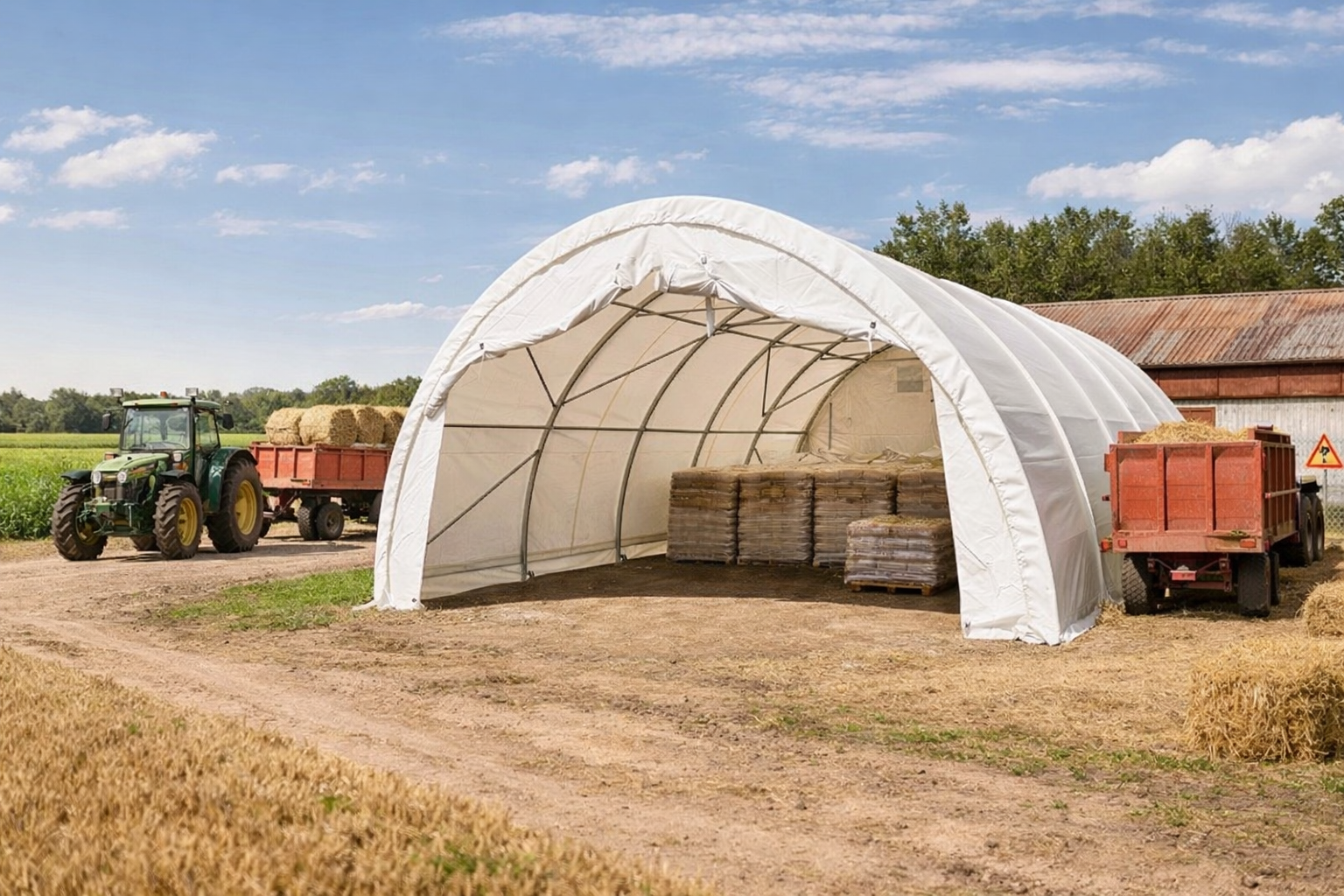
Until recently, building regulations in the agricultural sector involved a great deal of red tape, but today, thanks to changes such as the ‘lex silos’ and the 2026 amendment, many projects – including tented livestock pens – can be carried out much more simply and quickly. Increasingly, these structures are treated as mobile or temporary, which reduces administrative obligations and allows for greater freedom of action. Find out when you can build without a permit, and when a notification is sufficient.
A tent farm without paperwork in Poland? Find out when you can really build without a permit or notification
At first glance, it sounds suspiciously simple – but in many cases, you really can erect a structure without going through the whole official procedure. The key factor is whether the structure in question fits within the parameters that the legislator has deemed ‘safe’ for simplifications. If we’re talking about structures up to 150 m², which are single-storey, have a span of up to 6 metres and a height not exceeding 7 metres, and are directly related to agricultural production, then in many situations you can proceed without a permit or notification. This is a significant change, as just a few years ago even small projects could get bogged down in red tape for weeks on end.
In practice, this means that if you need livestock field shelters, space for machinery, feed or seasonal crop storage, you can erect the structure more quickly, without unnecessary delays. However, there are a few things to bear in mind that are often overlooked. The structure must be situated on agricultural or residential land, and its function must be genuinely linked to agricultural activity – a mere declaration is not enough. Additionally, it is advisable to have confirmation that you run a farm, e.g. through insurance with KRUS or an area of over 1 ha. These are details that matter in the event of an inspection and may determine whether the project is deemed compliant with regulations.
150 m² without formalities, 300 m² by notification – how to make the most of the new regulations to avoid getting bogged down in bureaucracy?
The 150 m² threshold is now the practical dividing line between complete freedom and a simplified procedure. However, if you need more space, the regulations do not block the way – you simply switch to the notification procedure. For structures between 150 and 300 m², all you need to do is submit a document, without having to go through the full building permit process.
It is important, however, that the structure is simple, has a span of up to 7 metres, and that its impact does not extend beyond your plot. It is this last condition that often determines whether the notification will go through without complications.
If you approach the matter sensibly, you can really benefit a great deal. In practice, this means the possibility of building larger storage facilities for machinery or agricultural produce without having to wait for months on end. On the other hand, it is worth knowing that the authorities have 21 days to raise an objection, so it is not entirely ‘immediate’. A well-prepared application – with a clear description of the facility’s function and its parameters – minimises the risk of problems. This is precisely where the purpose of the new regulations becomes clear: to simplify life for farmers, but without completely removing control over investments.
Tent halls and building regulations in Poland – when is it still ‘equipment’, and when do the problems begin?
This is one of the most practical issues, as it is precisely here that the regulations in Poland leave plenty of room for interpretation. An agricultural tent, if it is not permanently attached to the ground – i.e. it has no foundations or permanent anchoring – can be treated as movable farm equipment rather than a traditional building. This makes a huge difference, as in such a situation you do not have to go through the full building procedures, but can operate much more freely. In practice, this means faster assembly and, in many cases, no need to obtain planning permission.
The problem arises when the structure starts to resemble something permanent. If there are foundations, a permanent connection to the ground or fixed infrastructure, the structure may be classified as a shed or farm building. And this automatically entails different obligations. It is also worth remembering that the name ‘storage tent’ alone does not settle anything – what counts is the actual structure and how it is used. That is why, before assembly, it is a good idea to clearly define whether it is to be a mobile, seasonal structure, or something intended to last for years. This decision determines how much red tape you will actually face.
In practice , this is precisely why more and more people are opting for solutions that retain their mobile nature whilst remaining suitable for year-round use. This allows you to erect all-season storage tents which, despite their functionality, still do not require a full building permit, provided they are not permanently fixed to the ground. The same applies to structures designed as agricultural machinery tents – when properly selected and installed, they allow you to store equipment safely whilst maintaining flexibility in use and location.
180 days and then what? How can you avoid dismantling temporary structures every six months?
Regulations in Poland provide for a sort of ‘trial period’ for temporary structures. If you erect a structure for a maximum of 180 days, a notification is sufficient and you do not need planning permission. In theory, this makes sense – the legislator provides the opportunity to respond quickly to seasonal needs. In practice, however, many farmers see this as a problem, because after six months there is an obligation to dismantle the structure or switch to the permit system. It is precisely this moment that causes the most frustration.
There are, however, ways to approach this sensibly. You can plan the project as genuinely seasonal, e.g. for storing crops or equipment at a specific time of year. Alternatively, you can prepare in advance to apply for a permit if you know the structure is to remain in place for longer. It is also worth keeping an eye on legislative changes, as the farming community is pushing for amendments to these regulations. Agricultural chambers point out that the obligation to dismantle structures periodically is impractical, so further simplifications may be introduced in the future.
Building regulations for farmers, Lex silos and changes in 2026 in Poland: what do farmers actually gain and how can the regulations be applied to a specific investment?
The amendments introduced in recent years are not merely cosmetic – they represent a genuine shift in approach to farm investments. The ‘Lex silos’ of 2023 and further changes in 2026 have introduced clear rules that allow for faster action. In addition to increased area limits, new opportunities have also emerged, such as the construction of water tanks up to 30 m³ or the installation of energy storage systems up to 300 kWh upon notification. This shows that regulations in Poland are beginning to keep pace with the reality of farms, which are increasingly making use of modern solutions.
From an investment perspective, one thing is paramount – you have greater freedom, but you still need to act with due care. It is crucial to check the local spatial development plan (MPZP) and ensure that the planned structure actually meets the criteria for the simplified procedure. A well-planned investment is one that takes regulations into account from the outset – this way, you avoid last-minute changes and additional costs. These changes provide practical tools, but it is up to you to decide whether to make full use of them without risk.
In summary, the new regulations in Poland are genuinely changing the way farm investments are planned – they offer more freedom, but at the same time require informed decisions right from the stage of selecting the structure. If you approach the matter correctly, you can avoid a lot of red tape whilst gaining a functional space tailored to your day-to-day needs. That is precisely why, as a tent hall manufacturer, we recommend looking not only at the installation itself, but also at compliance with regulations and the possibilities offered by container shelters or tent-style agricultural halls. A properly selected solution allows you to operate faster, more flexibly and without unnecessary risk, and this is of huge importance today in running a modern farm.
 Previous
