
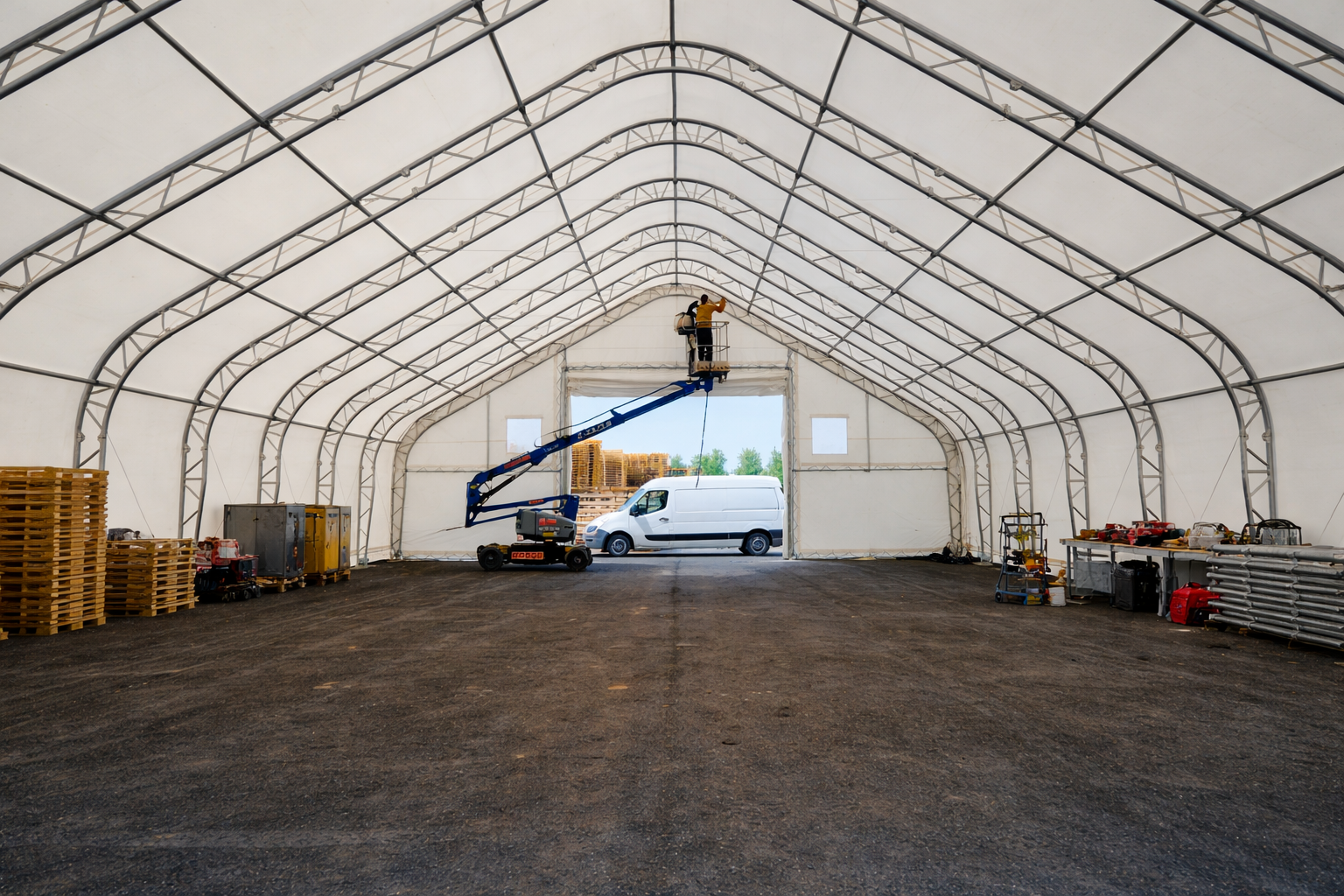
Wondering whether a tent halls is just a temporary solution or a viable investment that can drive business growth? In practice, more and more companies are choosing it not by chance, but by calculating - because it offers speed, flexibility and real savings. If the need for extra space arises, it is not always worth going for expensive construction. Sometimes it is better to opt for a solution that can be adapted to current needs and put into operation almost immediately.
Tent halls - is it worth investing in such a solution in today's business climate?
At first glance, it may seem like a 'temporary' solution, but in practice, tent halls are increasingly becoming a fully-fledged alternative to traditional buildings. And for good reason. If you're counting every penny and are pressed for time, you'll quickly notice that the lack of permit costs, shorter lead times and the possibility of flexible expansion make a huge difference. In many cases, the investment starts to work for itself almost immediately - especially if you need the extra space 'now' rather than in a year or two.
In practice, this means that rather than freezing your budget in a long and expensive build, you can rely on a solution that adapts to your pace of operation. Importantly, modern arched halls or workshop tents no longer have anything to do with stopgaps - they are structures that meet specific standards, are weatherproof and can operate year-round. If you have a business that needs to react quickly to market changes, this flexibility can be priceless.
For whom will a tent hall work best and when does it really make sense?
Not every investment suits every business model - and here too, it is worth taking a realistic approach. Tent halls work best where you need quick, functional space without a lot of paperwork. If you are active in logistics, production, agriculture or run a workshop, you will very quickly notice how much of a difference extra space makes. This is especially true if demand grows seasonally and you do not want to invest in a permanent extension.
This solution also works well in less obvious applications. Tent container canopies allow you to create practical storage facilities between modules, and in agriculture, they are increasingly being used as livestock shelters that provide protection from the weather without the need for brick buildings. If you want flexibility, mobility and the ability to quickly change the location or function of the space - this is when such an investment starts to make the most sense.
How much does a tent hall cost and after how long does it start to pay for itself?
This is one of the first questions that comes up - and rightly so. In practice, the cost depends on many factors: the size of the structure, the type of sheathing, the equipment or the purpose of the facility. Investing in a simple storage space will look different from investing in a more advanced solution with additional installations. However, what is usually most convincing is that the barrier to entry is significantly lower than with traditional construction.
In practice, analysing the current market offers, it is clear that the price range is really wide and well suited to different needs. The simplest solutions, such as small container canopies, can be purchased for as little as around £10,000, which gives a relatively low entry threshold for smaller companies. On the other hand, larger and more advanced structures - for example, arched tent halls or all-season structures with an area of several hundred metres - are already an expense of more than PLN 100 000, with the average cost per square metre usually in the range of PLN 150-400/m². Importantly, the price increases with the area, reinforcements and additional options, so the final valuation is often individual. Nevertheless, even with more extensive designs, we are still talking about an investment that remains much more accessible and flexible compared to traditional construction.
If you tailor the design well to your needs, the return on investment can come sooner than you assume. Especially when the hall starts to generate real revenue - for example, as additional production, storage or service space. It is also worth remembering that the absence of a lengthy investment process means a quicker start to operations, and this directly affects the rate of return. Ultimately, it's not just about the cost of the tent halls themselves, but about how quickly the space starts to work for itself and supports the growth of your business.
What are the real benefits of a tent halls in the day-to-day running of a business?
The biggest advantage that you will quickly feel is that you have complete control over the space and its purpose. In practice, this means that you can adapt the facility to exactly what you need here and now - without compromise. Changing the layout, enlarging the space or adapting the interior to accommodate new processes does not require complicated building work. This is a huge convenience, especially if your business is expanding or changing direction.
Then there is the purely operational aspect. Workshop tents work well as fast technical facilities, arched warehouse halls perform well as storage space, and various types of structures can serve a production or logistics function. Increasingly, agricultural tents are also being used as a simple way of securing machinery, crops or creating a functional work space on the farm. Importantly, the maintenance of such a space is usually cheaper than with classic buildings, while not losing functionality. If you value simplicity of management and want to avoid unnecessary fixed costs, this solution really starts to work in your favour.
As a tent hall manufacturer, we strongly recommend that you consider this solution, especially if flexibility and speed are important. These types of structures give you a great deal of freedom to tailor your space to suit your current needs, while at the same time reducing maintenance costs and significantly lowering your initial expenditure compared to traditional buildings. In practice, this means less paperwork, a quicker start and more control over the investment - without unnecessary risks.
 Previous
