
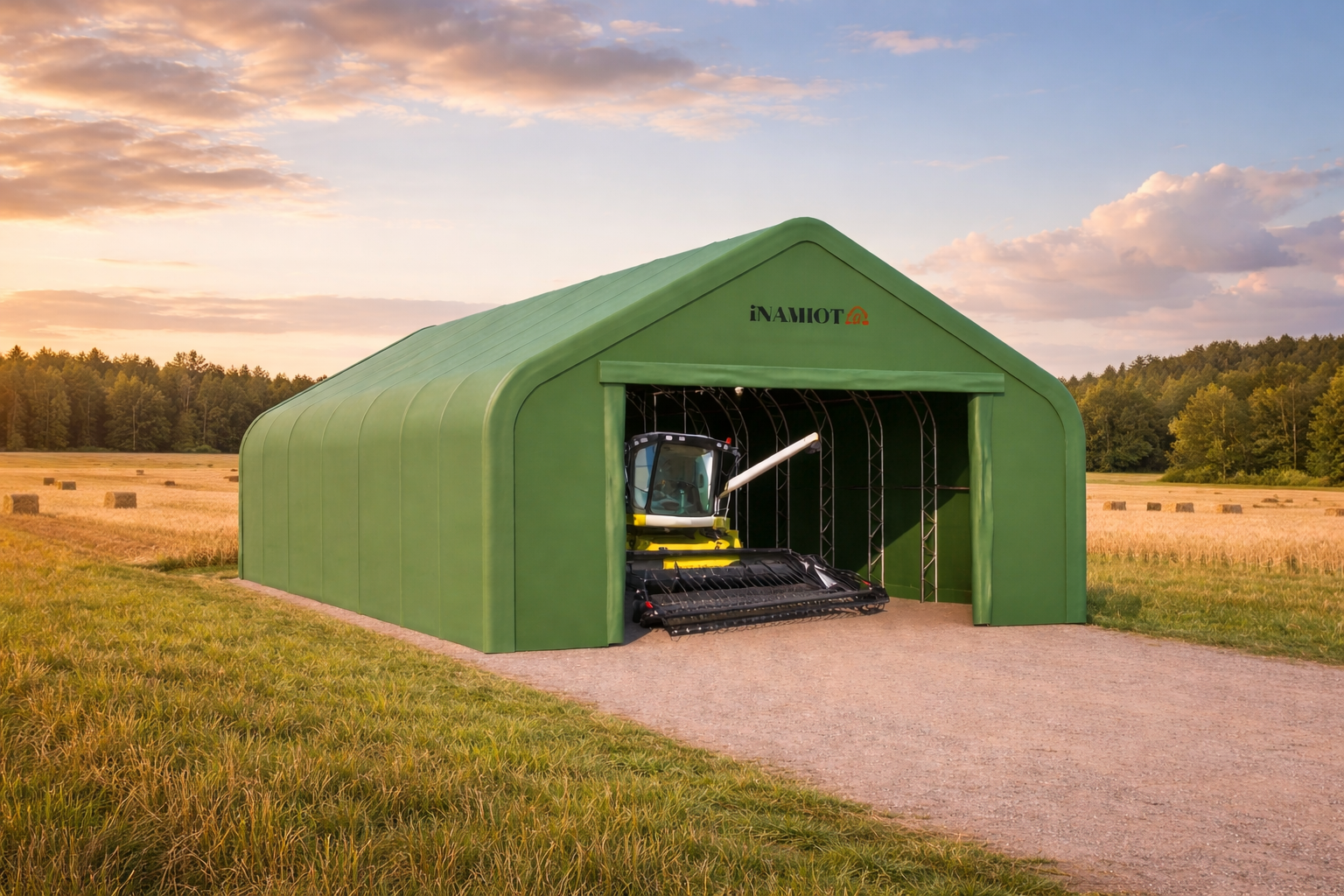
Tent halls are tempting in that they can be erected quickly, relatively cheaply and without a large construction site. In practice, however, the supervisory inspector is much less interested in what the structure is made of and much more in whether you have erected it in accordance with the law. In this post you will see step by step when a simple notification is sufficient, when a building permit is necessary, what technical requirements storage tents must meet under building law and how to prepare your documents so that you can simply pull out your binder during an inspection - instead of wondering whether you are about to receive a demolition order.
Tent halls and construction law - when do you need a permit and when is a notification sufficient?
In a nutshell, a notification is sufficient when the hall is temporary, while a building permit is needed when you treat it as a 'permanent' facility. The Polish Construction Law classifies tent covers (including halls) as temporary buildings, which means that you can erect them on the basis of a notification if you plan to use them for a maximum of 180 days and do not permanently connect the structure to the ground, e.g. with a concrete foundation.
However, if your hall is intended to operate for longer than these 180 days, serves as a permanent warehouse or production facility or stands in a location under special protection (e.g. a conservation area), you already fall under the full planning permission procedure - all-season storage tents therefore require a different approach.
In practice
If you erect such a tent/halls for a maximum of 180 days, without permanent connection to the ground (without foundations, classic anchoring, with the assumption of dismantling) - then this is treated as a temporary structure (the Act explicitly mentions "tent coverings"). In such a situation, you will make a notification to the district/city hall and the structure must be demolished no later than 180 days from the date of commencement of construction specified in the notification.
Storage tent and construction law - what technical conditions do you have to meet so that the supervising inspector does not order you to demolish it?
The answer is quite simple - agricultural halls and agricultural tents and industrial tents must meet essentially the same safety requirements as other storage facilities, just with regard to lightweight construction and sheathing. Even if you are talking about a 'temporary' solution, the law expects the structure to withstand the anticipated snow and wind loads, to have adequate anchoring to the ground and to be designed to current load-bearing standards.
Added to this are the fire safety requirements, which are particularly important with warehouses. The cladding material should be of a certain reaction to fire class, and the hall itself must be designed in such a way that it is possible to designate safe fire zones, escape routes and, if necessary, install fire alarm and extinguishing systems.
In practice
If you erect such a tent/hall for a maximum of 180 days, without any permanent connection to the ground (without foundations, classic anchoring, with the assumption of dismantling) - then this is treated as a temporary structure (the Act directly mentions "tent structures"). In such a situation, you make a notification to the district/city hall, and the structure must be demolished no later than 180 days from the date of commencement of construction specified in the notification.
Whether or not a tent hall is subject to property tax depends on whether the authority considers it to be a structure or a building as defined by law - so it is best to verify this with your local authority in each specific situation.
Tent halls and building law in practice - how to legalise a seasonal structure step by step, so that you can have peace of mind during an inspection?
If you want to have peace of mind with the building control, the first step is to establish whether your hall will be a temporary structure or a de facto permanent building. In practice, you start by checking whether there is a local plan for your plot of land and, if not, whether you need to apply for a zoning decision; only then can the designer realistically plan the parameters of the hall.
Once you are clear on the intended use and the duration of use, you decide: building notification (up to 180 days) or planning permission (longer, permanent, warehouse / production). For the notification, you attach, among other things, sketches, a technical description, an indication of when assembly and dismantling will take place; for the permit, you will already need a full construction project with opinions, agreements and statements from the designers.
The next steps are already the more 'technical' part, but still very important. After filing the application, you have to wait 21 days for the office to raise no objections, and with a permit you wait for the administrative decision and its validation. Only then do you order the structure, arrange for the erection team and organise the construction site - even with a tent halls we are talking about construction work within the meaning of the Act. Once the building has been erected, it is a good idea to carry out an internal 'acceptance inspection': check compliance with the design, the marking of escape routes, information signs and, if necessary, carry out a fire inspection.
In practice:
Irrespective of the time of use, you are still bound by technical, fire, health and safety conditions, mpzpzp/WZZ - i.e. you have to check whether such a warehouse can be erected at all in a given area, what are the permissible heights, distances from plot borders, etc.
How do I prepare the documents if I want to register a tent halls?
On the paperwork side, it is worth following a simple but consistent checklist. To get started, you will need a document confirming the legal title to the property (e.g. title deed, lease agreement), an up-to-date map for design purposes and verification whether a local plan applies to the site or whether a zoning decision is necessary - without this, the designer's hands are tied.
Another packet includes formal documents: designers' declarations on the compliance of the project with the regulations, required branch agreements (e.g. fire, sanitary, occupational health and safety), as well as the application itself or the permit application with a set of attachments. In the case of larger facilities, the BIOZ (occupational health and safety) information and the work organisation plan are also useful to show that the assembly of the hall will be carried out in a safe manner.
Utility tents are a convenient and relatively quick way to temporarily increase storage space - without having to erect a traditional building. At inamiot.EN you will find a wide selection of robust, high-quality marquees to suit your needs, whatever your industry. If you have any doubts as to how your particular construction fits in with the building regulations, the safest thing to do is to enquire at your local authority or district council about your planned hall and get a clear answer before erecting it.
 Previous
